
Write down your investing strategy
Every investor has a philosophy. The only question is whether it is written down, or renegotiated from memory at the worst possible moment.

Why should I write down my investing strategy?
Because memory is not a storage device; it is an editor. Under stress it quietly rewrites what you believed to match what the price is doing, and under FOMO it rewrites your standards to fit the stock you suddenly want. A written philosophy holds still while your mood does not. Written down, "obvious opportunities are rare and I must wait for them" is a rule you can point to at the moment of temptation. Remembered, it is a mood, and moods lose to other moods. The document is how the calm version of you outvotes the stressed version at the exact moment the stressed version holds the pen.
There is a second, quieter benefit. Writing forces precision. A thesis you cannot write down is a feeling, not a thesis, and the same holds for a strategy. The sentence "I buy quality companies for the long term" survives in your head for years without ever meeting a hard case. On paper it immediately raises the questions that matter: what counts as quality, what price is too high for it, and what would make you leave. The page is where vagueness goes to die.
What belongs in a written investment philosophy?
Five short sections cover most of it. The game you play: your horizon, your style, and the circle of competence you actually have, named specifically. Your entry bar: what a company must show before you buy, and what the price must offer. Your sizing rules: positions as percentages of the portfolio, never absolute amounts, scaled by conviction. Your sell rules: the conditions that end a position, written in business terms such as the story changing, the moat weakening, or heavy overvaluation. And your documented weaknesses: the specific mistakes you repeat. One page is enough. A philosophy that runs to twenty pages is a way of avoiding the five sentences that matter.
Two details in the sizing section do most of the protective work. First, percentages, never amounts: a position defined as a share of the portfolio scales with you and keeps the risk conversation honest, while a position defined in money invites you to anchor on what a loss would buy. Second, conviction-scaled: your best-understood idea earns a real allocation and a thin idea earns a thin one or none, which is the written form of betting big only when it is obvious.
Should my written philosophy include a checklist?
Yes. The philosophy states your standards; the checklist is how you apply them under pressure, the same way pilots who know perfectly well how to fly still run the pre-flight list. Charlie Munger's investing principles checklist in Poor Charlie's Almanack is the classic starting point: risk, independence, preparation, intellectual humility, analytic rigor, allocation, patience, decisiveness, change, and focus. Adapt it to your own style and staple it to the philosophy. Its job is narrow and valuable: a checklist protects you from omission, from skipping the uncomfortable question because the stock is exciting. It does not protect you from bad judgment, and it is not supposed to. Judgment stays your job.
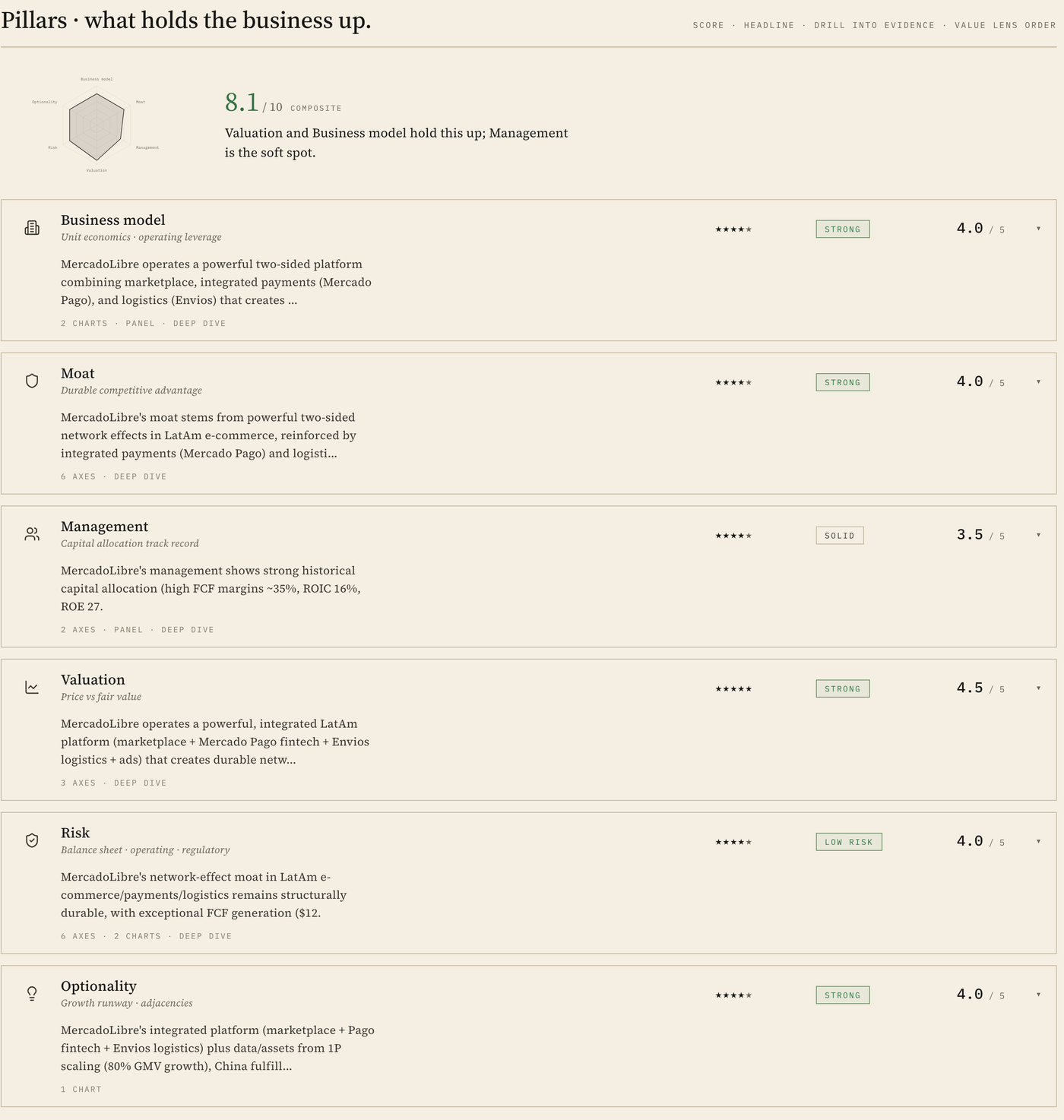
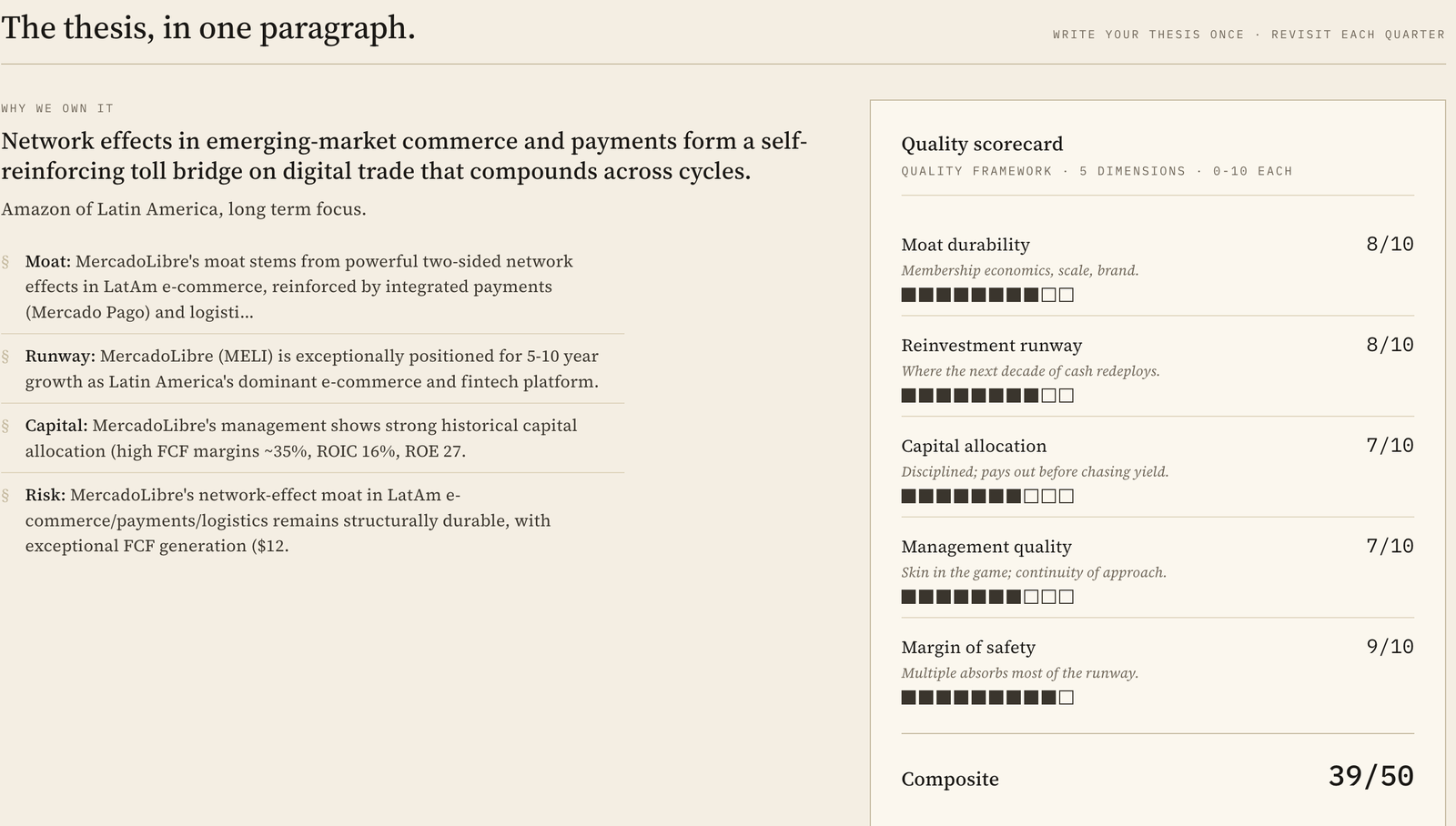
This is, in fact, how Invest Board itself is built. The AI runs a Munger-style checklist on every company and scores the categories that matter: moat, management, valuation, business model, risk, and optionality, each with its reasoning written out (the full framework is on the methodology page). What it deliberately does not do is hold your conviction for you. The scores are an input, the way a pre-flight list is an input; the opinion, the sizing, and the decision to act remain yours, because a conviction you outsourced is exactly as durable as the next red day. The machine checks for omission. You supply the judgment.
How is this different from an investment journal?
The journal records decisions; the philosophy is the standard the decisions are tested against. A journal entry says what you bought, at what price, believing what. The philosophy says what you are allowed to buy at all, how big, and what would make you sell. They work as a pair: the journal catches you drifting from the philosophy, and the accumulated journal evidence is what earns a change to the philosophy. One is the log, the other is the law. Most investors keep neither; keeping both is a durable edge that costs an hour a month.
The pairing is also what makes the philosophy operational rather than decorative. Inside Invest Board the same structure exists as a workflow: the thesis written in one paragraph, the edge named, the kill criteria typed as explicit conditions the system monitors. The point is not the tool; it is the shape. A strategy becomes real the moment it is written somewhere a later, wearier version of you will be confronted by it.
How do I write down my weaknesses honestly?
Use evidence, not adjectives. Go through your worst decisions and name the mechanism that produced each one, then write the rule that blocks the mechanism. An investor who knows drawdowns cost him sleep writes a sizing cap so no single position can force a bad night. An investor who knows FOMO is his recurring tax writes a waiting period for any stock that has already run. An investor who notices his results got worse when he followed other investors on social media writes that opinion in and logs off. The weakness list is the most valuable section of the document, and it is the one nobody else can write for you.
Notice what this section is not. It is not self-criticism, and it does not require fixing the weakness. You do not have to become a person who feels nothing in a drawdown; you have to be a person whose rules were written by someone who knew the drawdown would feel like that. The document does the being-rational so that you only have to do the obeying, which on a bad day is the easier job.
Should I write down long-term themes too?
Yes, separately from positions. A themes page holds the handful of long-term trends you genuinely understand and would deploy into given the right company at the right price. Writing a theme down does three things a watchlist cannot: it forces the thesis to be falsifiable, it timestamps what you believed before the market agreed, and it pre-authorises patience, because a theme with no qualifying company yet is a reason to wait, not to reach. Themes also decay; review them and retire the ones the market has fully priced or the facts have falsified.
Themes are also where the philosophy earns its keep between positions. The rare, obvious opportunity tends to arrive inside a trend you have understood for years, at a moment when the market briefly disagrees. Having the theme on paper, with the reasoning dated, is the difference between recognising that moment and discovering it afterwards in someone else's year-end letter.
How often should the written philosophy change?
Principles should change slowly and positions can change fast; the document should make that asymmetry visible. Review the philosophy on a calendar, once or twice a year, never in the middle of a drawdown and never on the day a stock is running. When you do change it, date the edit, keep the old version, and write one line about why. Your philosophy gets a changelog. If an edit only makes sense in light of a position you currently want to take, that is not evolution, it is the document being tortured, and the changelog is what catches it.
There is a paradox here worth naming: a written position is easier to change than a remembered one. Beginner's mind, the willingness to drop a view without ceremony the way Druckenmiller does, is not weakened by writing things down. It is enabled by it, because a written thesis shows you exactly which assumption broke, so changing your mind becomes a precise act instead of a loss of face. What you cannot see, you defend. What you wrote down, you can revise.
Start with one page
Tonight, not someday: the game you play, the entry bar, the sizing rules, the sell rules, the weaknesses, the themes. Six headings, a few sentences each, dated at the top. It will feel too simple, and it should; the value was never in the sophistication. It is in the fact that from tomorrow on, there is a version of your judgment that the market's noise cannot edit.