

01
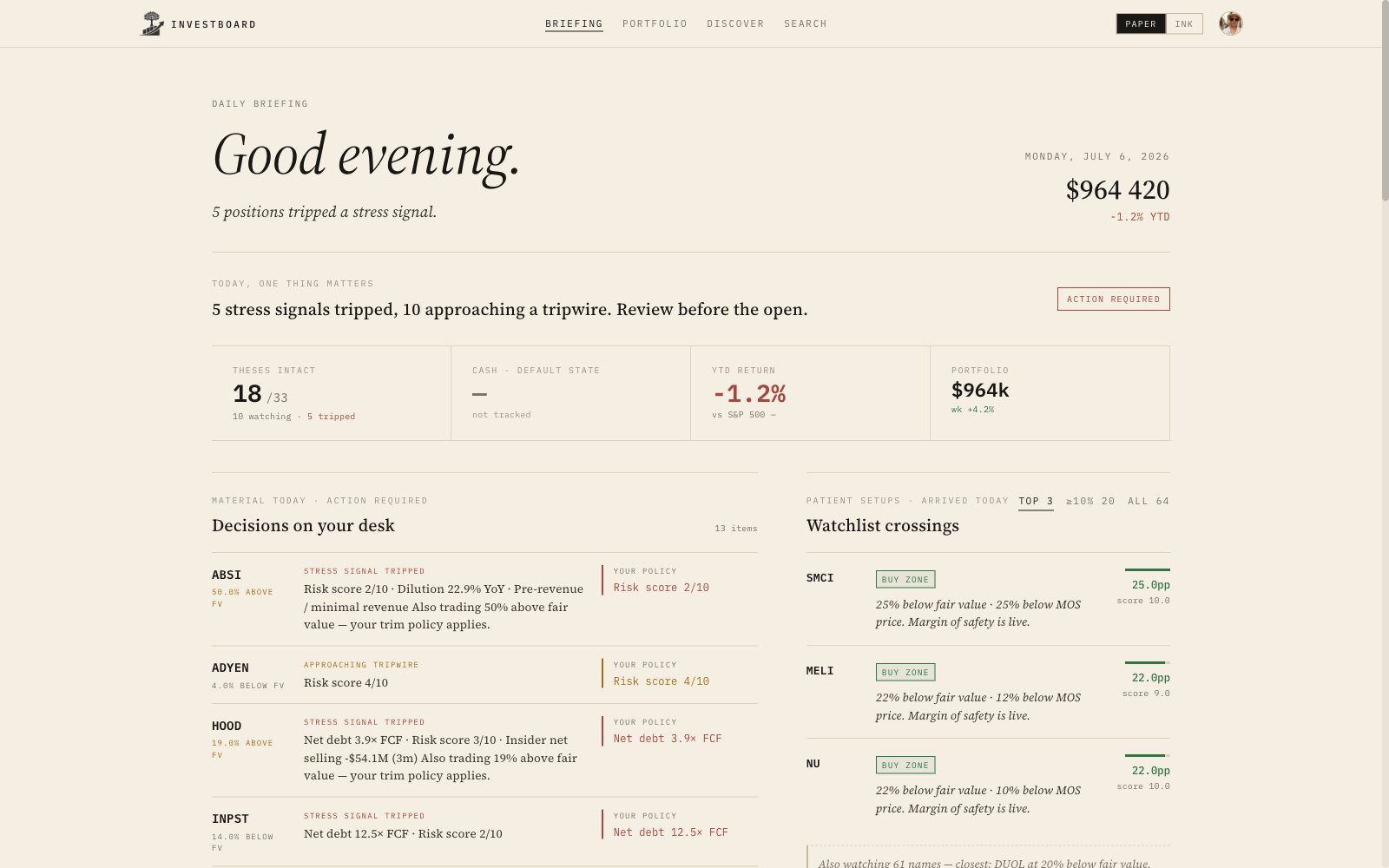
The Briefing
Three minutes before the open — every watchlist name and owned position, checked against your thesis.
 INVESTBOARD
Conviction built before you buy. Courage held when prices fall.
One briefing a day that stays silent — until it shouldn't.
investboard holds every thesis you wrote when you were calm — the claim, the moat, the kill criteria — and tests each day's facts against it. Prices refresh once, after the close; the briefing is waiting before the open. If nothing crossed a line you drew yourself, it says so in one sentence, and returns you to your morning.
That is what the conviction is for. When a price falls on an intact thesis, you can buy more instead of flinching. When it runs past your value — or the story changes — you can sell without ceremony. The research earns the calm; the calm earns the returns.
Read the five principles →See how the machines reason →Three minutes before the open — every watchlist name and owned position, checked against your thesis.

Watchlists for every stage — research, watch, owned — with concentration, cash, thesis health and insider activity weighed.
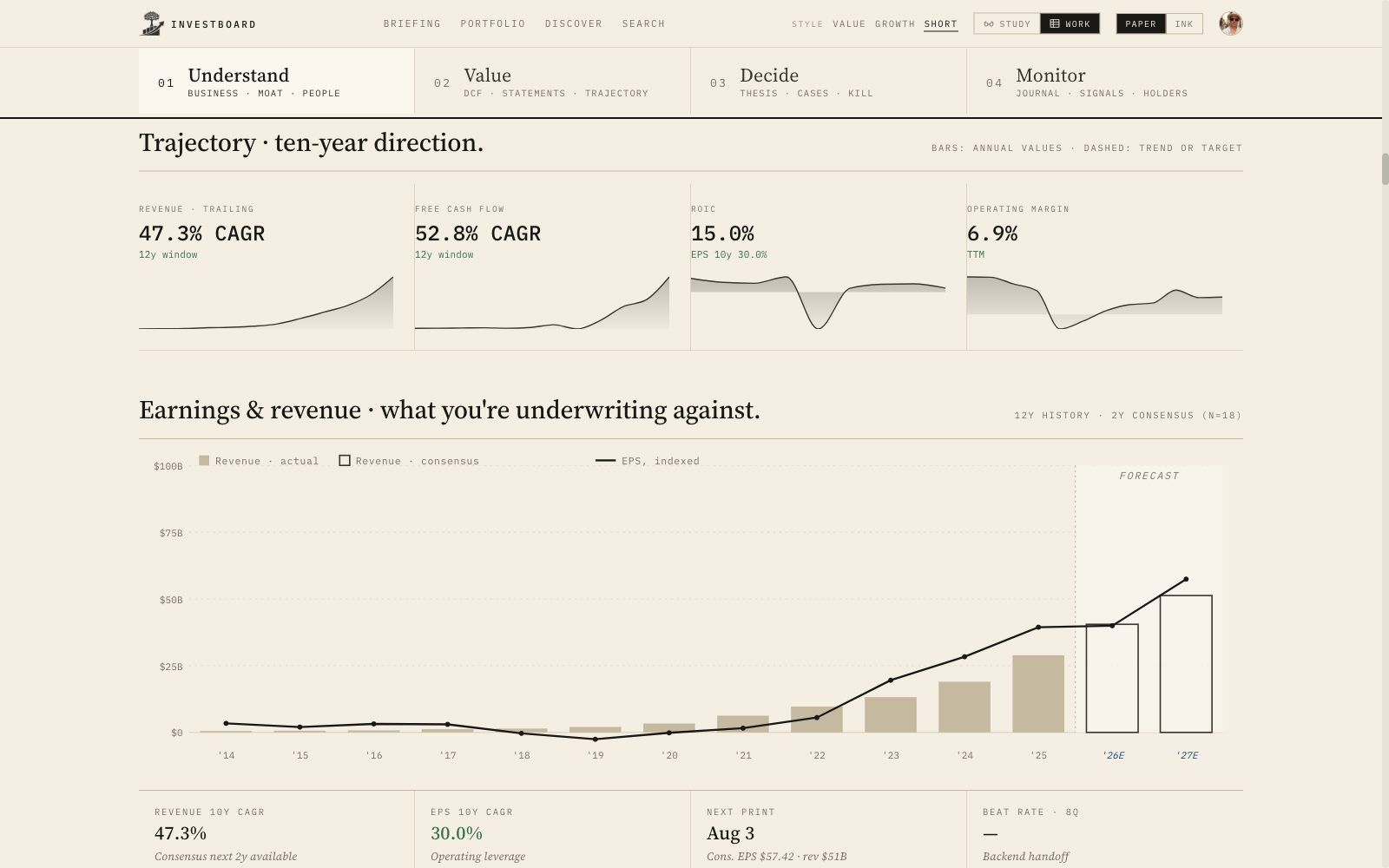
The whole research room: agents that read the filings and reason through what they find, decades of numbers drawn, your journal and thesis kept beside the price.

New ideas from Ackman, Pabrai, Buffett and more — tracked with their real returns — and agent reasoning on growth and margins.
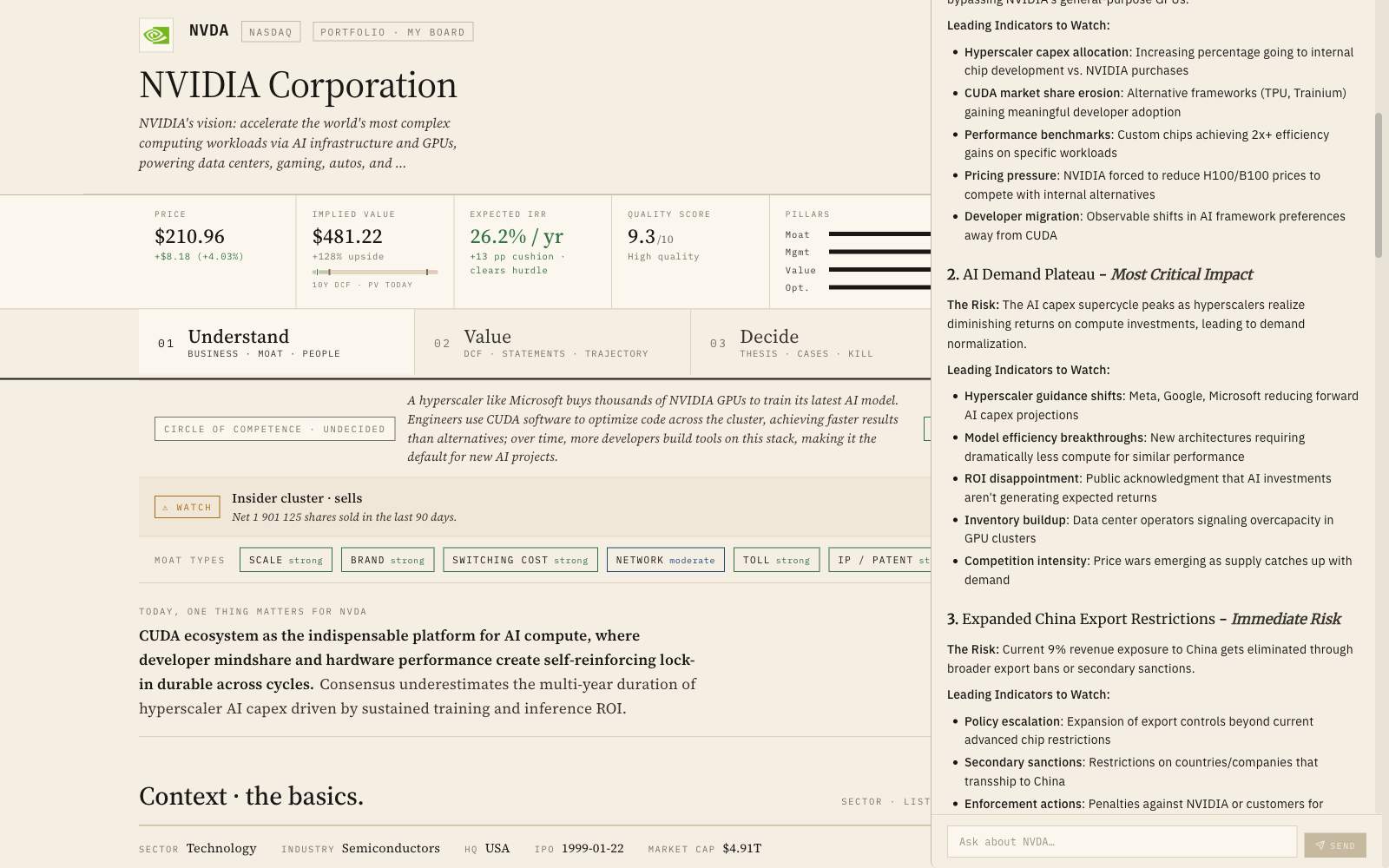
A running conversation with the agents that already read the filings — ask about the company on screen, or the whole portfolio, and get a reasoned answer with a decade of numbers behind it.
Overnight, one page is written. Three minutes before the open — and nothing tugs at your attention until tomorrow. Peace of mind, by construction.
Every position is held against the thesis you wrote at entry — kill criteria specific enough that a stranger could agree they've tripped. A tripped criterion, a watchlist crossing, a margin-of-safety band entered: each gets one sentence. Everything else gets silence, so you never fill the quiet with action.
And on the rare day the market panics over a business you understand, the briefing says that plainly too — this is the moment your conviction was built for.
CRWD — trading 13% above fair value, margin of safety gone. Insider net selling $12M this quarter. Your trim policy applies. Eleven other theses are intact.
The wait — 41 days since your last trade. That is the strategy working.
“It is waiting that helps you as an investor, and a lot of people just can’t stand to wait.”Charlie Munger
We do less than the terminal — deliberately. One considered look per day, and no machinery designed to make you trade. The restraint is the product.