
Margin of Safety
Every valuation is wrong. The margin of safety is the explicit acknowledgement of that, and the buffer that lets a wrong valuation still earn a fair return.

What is margin of safety in investing?
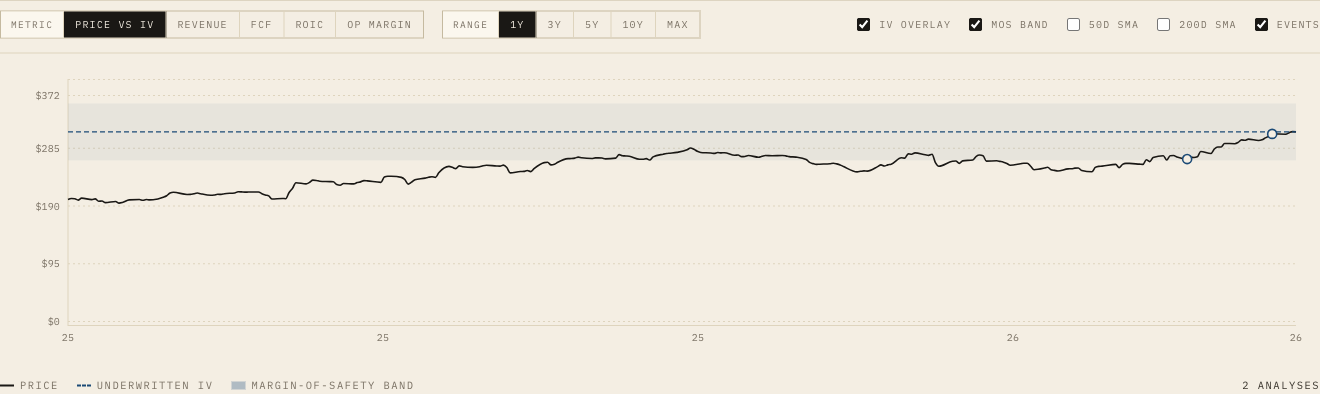
Margin of safety is the gap between the price you pay for a stock and the intrinsic value you believe the business is worth. The wider the gap, the more wrong you can be about the intrinsic value and still earn a fair return. Graham coined the phrase in the 1930s; Buffett has called it the three most important words in investing. It is not a discount on a screen: it is the explicit acknowledgement that your valuation is an estimate, and the buffer protects you from the inevitable error in that estimate.
Graham used a bridge metaphor: an engineer building a bridge to carry ten-ton trucks designs it to carry thirty tons. The thirty tons are not because the engineer thinks ten-ton trucks weigh thirty tons; the thirty tons are the engineer's confession that her load estimates are imperfect and that overload is catastrophic. The investor who pays forty cents on a dollar of intrinsic value is doing the same thing: admitting in advance that the dollar might really be eighty cents and demanding compensation for the unknown.
How do I calculate margin of safety?
First settle on a fair value, then apply one discount. The fair value can come from three serviceable methods: the multiples method, comparing the current P/E or EV/EBITDA to a defensible long-run average; the forward DCF; and the reverse DCF, which solves for the growth the price already requires and is the most useful for serious work because it exposes the assumption you are actually buying. The discount is simpler than the valuation: in Invest Board the margin-of-safety price is half of fair value, the number Mohnish Pabrai and Phil Town use. Graham's classic figure was a third off. We take the stricter one, because a private investor cannot average down with a fund's capital, and because one number cannot be renegotiated on the day the price arrives.
The temptation among first-time DCF users is to extend the precision of the inputs to four decimal places and pretend the output is reliable. It is not. The integrity of the method is in the discount you require, not in the precision of the central estimate. Pick the method that fits the business: reverse-DCF for cash-generative compounders, multiples for cyclicals where reversion is the bet, forward DCF for early-stage growth where the intrinsic-value question is genuinely uncertain, then apply the discount honestly.
What discount qualifies as a real margin of safety?
Half of fair value, for every business. Many practitioners run a sliding scale instead: a quarter or a third off for a high-quality compounder, more for a cyclical whose intrinsic value is itself volatile, more again for a turnaround. The scale is defensible and it is also where the trouble starts, because the discount you require has a way of shrinking to fit the stock you have fallen for. One number removes the negotiation. If a compounder never comes to half of your fair value, the answer is to wait, or to raise the fair value only if the business has earned it, never to lower the bar. The honest framing is that the discount is the price you charge for the uncertainty you cannot eliminate, and the charge is set in advance.
Klarman's book is titled Margin of Safety for a reason, and the answer Klarman gives to "how much?" is: enough that you would own the stock if a third of your investment thesis turned out to be wrong. The mental test is to halve every growth assumption, raise the discount rate by 200 basis points, and ask whether the price you are paying still produces an acceptable return. If yes, you have a margin. If no, you are paying for a story you cannot defend if the story slips.
Why does margin of safety matter more than precision in valuation?
Because every valuation is wrong. The DCF you built assumed a growth rate, a margin, a discount rate, a terminal multiple. Change any one and the answer moves 20–40%. The margin of safety is the recognition that you cannot precisely value a business and that the response to imprecision is humility, not better spreadsheets. Buffett's line: 'I'd rather be approximately right than precisely wrong' is the philosophical core of the discipline. The DCF estimates; the margin protects.
This is the philosophical bridge between Graham and Buffett. Graham was a deep-value buyer of cigar butts where the discount was the whole thesis. Buffett evolved the discipline toward quality compounders where the discount is smaller but the business is better. Both approaches share the same underlying recognition: the valuation is an estimate, and the response to estimates is to require compensation for being wrong. The form of the compensation differs; the principle does not.
What is the connection between margin of safety and permanent loss of capital?
Margin of safety is the operational answer to the question 'what protects me from a permanent loss?' Permanent loss happens when the business is impaired below your entry price and never recovers. The margin reduces the probability of a permanent loss in two ways: by lowering the entry price so the business has more room to disappoint without you being underwater, and by forcing the analysis that should have caught the impairment risk in the first place, because to justify the discount you have to articulate what the worst case looks like.
Permanent loss is the only loss that matters across a long-horizon career. A 30% drawdown that recovers is recoverable; a 30% drawdown in a position that turns out to be permanently impaired ends careers. Margin of safety is the single most reliable defence against the second kind, because it forces the analysis that would otherwise be skipped. To require half off, you have to write down what the bear case looks like. Writing the bear case is the work that catches impairment risk before you fund it. The full discipline is covered in the value investing process we follow.
When does margin of safety not protect you?
When the business is in structural decline and the intrinsic value you used to set the discount was itself wrong. A 50% discount on a value trap is still a value trap; the multiple keeps compressing because the future cash flows keep deteriorating, and the margin you thought you bought is illusory. Margin of safety protects against estimation error within a healthy business; it does not protect against owning the wrong business. The defence against the wrong business is moat analysis and management quality, not the discount.
Newspaper stocks in the 2010s are the canonical example. Every valuation metric implied a deep margin of safety; every year, the margin compressed because the intrinsic value itself was shrinking faster than the multiple. The investor who screened on cheapness and bought lost money continuously. The investor who screened on cheapness, then ran moat analysis on every cheap name, and rejected the ones with structural decline, did not. The defence is the analysis, not the spreadsheet.
How is margin of safety different from a stop-loss?
A stop-loss is a price rule: sell if it falls a fixed percentage. Margin of safety is a buy rule — only buy if the price already gives you a buffer against being wrong about value. The first concedes you cannot value the business and tries to manage drawdown after the fact. The second insists you can roughly value the business and demands compensation for the uncertainty before entry. The Graham-Buffett tradition deliberately favours the second because it changes the question from "what is the market doing" to "what is the business worth."
The stop-loss school treats the market price as the truth and manages the trade around it; the margin-of-safety school treats the market price as opinion and the intrinsic value as the truth, then demands a discount on the opinion before acting. The two philosophies produce different careers. The stop-loss trader is busy every week; the margin-of-safety investor is busy at the moment of underwriting and then patient for years. Across a forty-year horizon, the patient approach has compounded more capital with less friction in nearly every dataset that exists.
What this means for your watchlist
For every position you currently hold, write down the intrinsic value you used to justify the entry, the price you paid, and the discount that gap produced. If the discount was less than half, you bought thinner protection than the rule asks for; write down why. If you cannot remember the intrinsic value, you did not enter with a margin — you entered with a hope. The honest inventory is the starting point. The next entry you make can be different.