
Research at the speed of reading
Most of investment research is gathering, and gathering is the part a machine does well. What remains is the part that was always the work: deciding what the evidence means.

What is the Invest Board Co-Pilot?
A research agent that sits beside the page you are reading and answers questions using the same data the page is built from. It comes in three scopes. On a company page it knows that company: filings, fundamentals, the analysis scores, insider trades, super-investor holdings, price history and the macro cycle. On the portfolio it knows your positions, your theses and your journal. On the discover page it knows the whole universe and can screen it. It is a reading partner, not a signal service. It does not place trades and it does not tell you what to buy.
The scoping is the design decision that matters. A general chatbot with a search box knows nothing about what you are looking at, so every question starts with you explaining the context. A scoped agent starts where you are: on the Nvidia page it already knows the ticker, the analysis, the price history and the filings, so the question can be the actual question. The cost of asking drops, and when the cost of asking drops you ask more, which is the whole point.
What data can the AI agents actually access?
Ten tools on the company scope: company fundamentals, the full analysis scorecard across sixteen dimensions, historical financial trends for up to ten companies at once, the macro indicators and cycle phase, insider transactions, a retrieval search over SEC filings and analyst documents, super-investor 13F holdings, revenue segments, price history and performance, and a live web and X search for anything outside the database. The portfolio scope swaps in portfolio-wide risk analysis, per-position detail, your journal entries and company comparison. The discover scope adds screening, theme discovery, sector overviews and insider scanning across the universe.
| Scope | What it can reach |
|---|---|
| Company | Fundamentals · analysis scorecard · financial trends · macro cycle · insider activity · filings search · 13F holdings · revenue segments · price history · web and X search |
| Portfolio | Board overview · per-position detail · portfolio risk · journal entries · company comparison · financial trends · macro · filings search · 13F holdings · web search |
| Discover | Screening the universe · theme discovery · sector overview · insider scanning · company detail · comparison · portfolio overview · macro · filings search · web search |
Two things follow from that list. First, most of it is your own data and the analysis you already paid for, not a general model guessing from memory. When the agent says the moat scores 9 out of 10, it read the scorecard. When it says insiders sold 1.9 million shares, it read the transactions. Second, the retrieval tool over filings is what separates a useful answer from a plausible one, because it lets the agent quote the document instead of recalling the internet.
What is bottleneck analysis and how does an AI agent help?
Bottleneck analysis asks where the constraint in a value chain sits, because that is where the pricing power ends up. Demand for AI compute is enormous, but demand is not the interesting part: the question is which link cannot expand. Advanced foundry capacity, high-bandwidth memory, advanced packaging and power all compete for that role, and the answer decides who captures the economics and who pays. It is exactly the kind of question that costs a human analyst a day of reading across a dozen companies, because the evidence sits in supplier disclosures, lead-time commentary and capacity announcements rather than in any single filing. An agent that can read across all of it in one pass turns that day into a few minutes of review.
Work the Nvidia case through by hand and you can feel the cost. Demand for AI compute is not in dispute. What you need to know is which link in the chain cannot expand fast enough, because that link sets the price for everyone. Candidates are the foundry at leading-edge nodes, the memory that feeds the accelerator, the advanced packaging that assembles them, and the power and cooling for the building they sit in. Each candidate implies a different set of winners. Getting there by yourself means reading four supply chains.
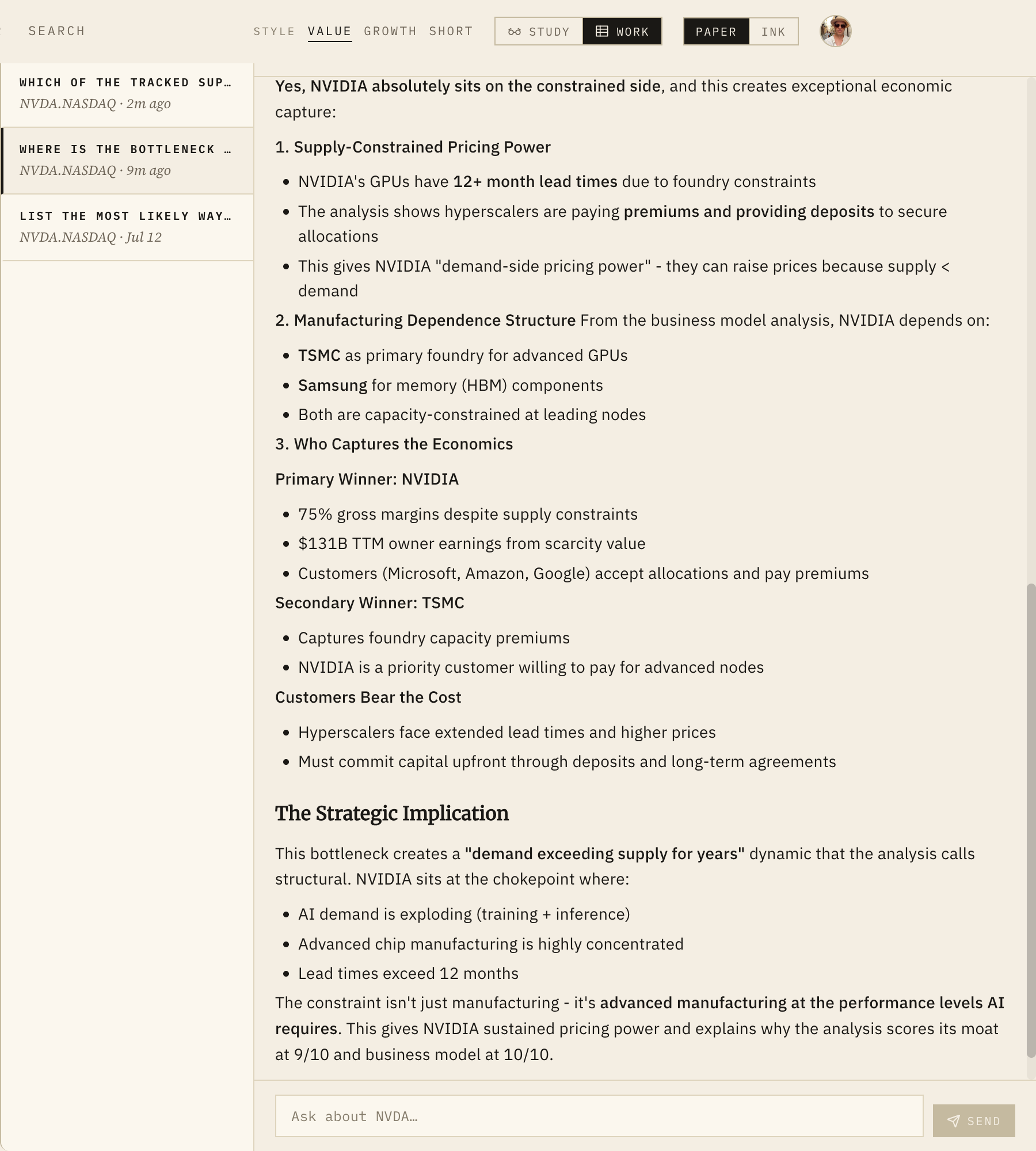
The answer is not the interesting part. The structure is. Constraint, then who has priority access to it, then who captures the margin, then who bears the cost. Once a question is framed that way it can be asked of any industry: pharmaceutical manufacturing capacity, shipping tonnage, grid interconnection queues, rare-earth refining. The agent is useful here not because it is clever but because it reads the supplier disclosures, the lead-time commentary and the segment data in one pass, and then has to commit to a named constraint rather than gesturing at a theme.
Notice also what the answer does at the end: it connects the structural read back to the scores on the page, moat at 9 and business model at 10. That is the useful shape of a machine answer. It is not a separate opinion floating beside your analysis, it is an explanation of the analysis you already have.
How does an AI co-pilot make investment research more efficient?
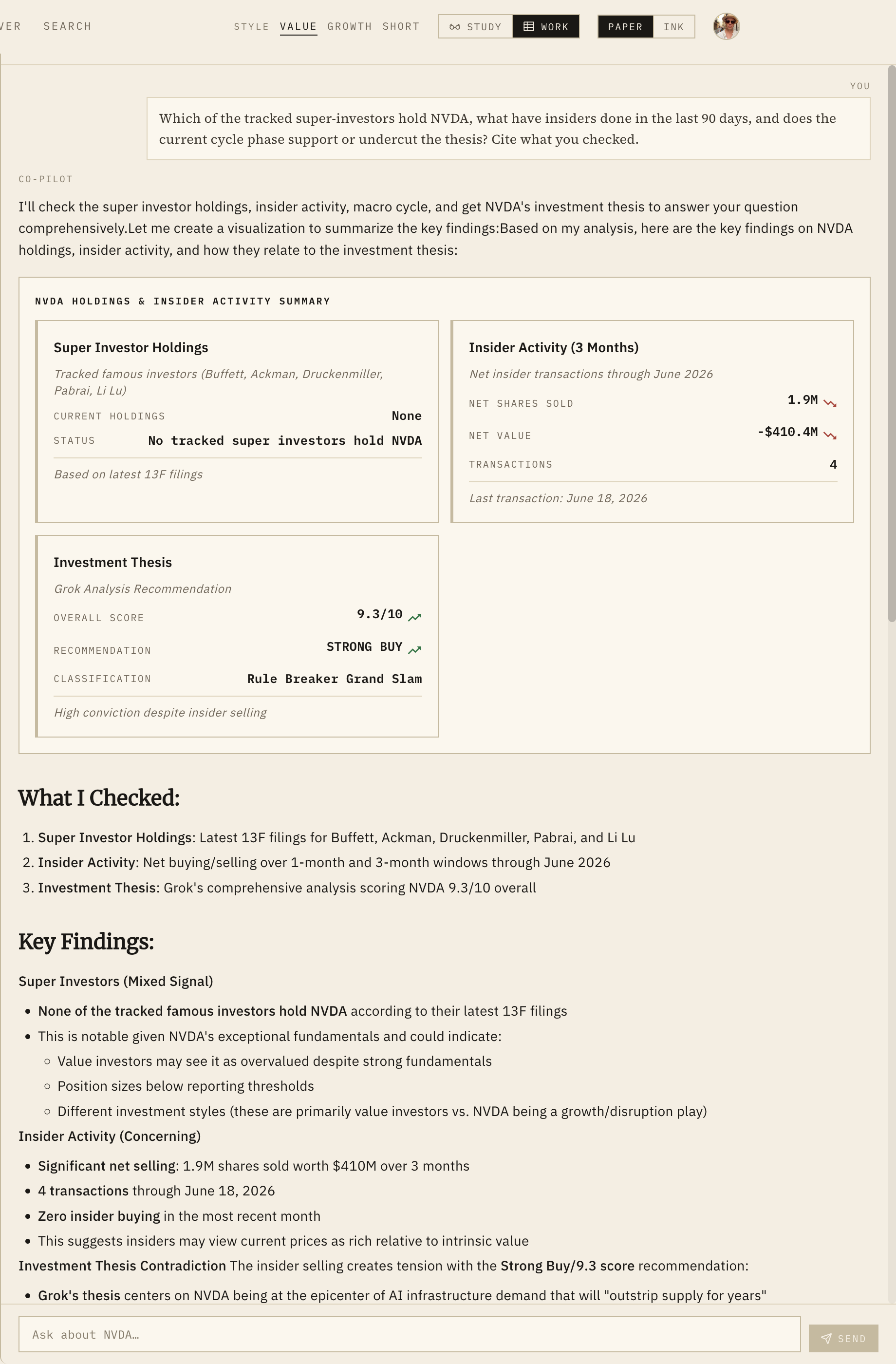
It collapses the gathering, which is most of the work and none of the judgment. A normal question like "do any of the investors I follow own this, what have insiders done, and does the cycle support the thesis" means three sources, three tabs and twenty minutes. The agent answers it in one pass and shows what it checked. That leaves your time for the part that cannot be delegated: deciding whether the evidence supports a thesis you would hold through a decline. Research on institutional adoption of these tools makes the same point, that the measurable gain shows up as analyst throughput and coverage depth rather than as better returns.
Take the question in the figure at the top of this page. Which tracked investors hold Nvidia, what have insiders done in the last ninety days, and does the cycle support the thesis. Answering that by hand means opening nine 13F filings, a Form 4 history, a macro dashboard and the analysis, then holding four things in your head at once. The agent returned all of it in one pass, listed the three sources it checked, and flagged the tension: none of the tracked value investors own the name, insiders sold 1.9 million shares worth $410 million over three months, and the analysis still scores it 9.3 with a strong buy. Three facts that do not agree, put side by side.
That is the efficiency worth having. Not a faster route to an answer, a faster route to the disagreement. The twenty minutes you save on gathering are worth something. The habit of asking three cross-checks instead of one, because each now costs seconds, is worth considerably more.
Be precise about what this buys you, though. Edges in investing are informational, analytical or behavioural, and a reading machine does not hand you the first two: everyone's agent reads the same filings, and the analysis is only as good as the questions you bring. What it buys is time and coverage, and the durable edge for a private investor was always the third kind anyway: the patience to wait, and the nerve to act when the work says yes and the market says no. A tool cannot have that for you. It can make room for it.
What questions is a research agent best at?
Anything that means reading across many places at once. Cross-sectional questions: which companies in a sector have improving margins. Ownership questions: which tracked investors hold this and how the position changed. Structural questions: where the constraint in a supply chain sits and who captures the economics. Chronological questions: what has changed in my portfolio since my last review. It is weakest exactly where you would expect: judgment about the future, anything requiring taste, and any question whose answer is not in the data.
A short list of the questions that repay the effort, in the shape they actually get asked:
- Which companies in this sector have improving operating margins over the last eight quarters, and which are declining.
- Which of the investors I follow own this name, and how has the position changed across the last several filings.
- Where is the constraint in this value chain, and who captures the economics because of it.
- Walk through every position in my portfolio and tell me whether the thesis is intact, on watch, or tripped, with one line of reasoning each.
- Build me a screen from this sentence: founder-led, under 15 times free cash flow, ROIC above 20%, North America.
Every one of those is a gathering problem wearing the costume of an analytical one. That is what makes them a good fit. The questions a machine cannot help with are the ones where the data runs out: whether this management team will still be disciplined in five years, whether the moat survives a technology you have not seen yet, whether you personally can hold the position when it falls by half.
Does the AI Co-Pilot make investment decisions?
No, and the design is deliberate about it. It reports what the data says, including when the data disagrees with itself. Ask about a company with a high score and heavy insider selling and it will put both in front of you and name the contradiction rather than resolving it for you. Every answer carries the general investment analysis disclaimer, and the judgment stays with the reader. An agent that told you what to buy would be worth less, not more, because you cannot hold a position on borrowed conviction.
This is a house rule rather than a limitation of the technology, and it comes from the same place as the rest of the method. Conviction cannot be transferred. If you buy because an agent sounded confident, you own a position and none of the understanding that would let you hold it, which is the worst of both worlds: the risk without the patience. Read the agent the way you would read a very fast, very literal research assistant. It has read more than you have. It has understood less.
Can the Co-Pilot search the web and recent news?
Yes. Alongside the internal database it has a web and X search tool for real-time market intelligence, which is how it answers questions about events that postdate the last filing. That distinction matters when you read the output: numbers from the database carry a date and a source, and web material is exactly as reliable as the web. Ask it to cite what it checked and it will tell you which tools it used, which is the fastest way to see whether an answer rests on a filing or on a headline.
Provenance is the discipline that makes any of this safe to use. Every headline number in the product carries its date and its source, and the agent inherits that convention: it names the tools it used, dates the filings it read, and marks web material as web material. When it does not know, the honest answer is that the data is not there, which is also what a dash means everywhere else in the app.
Can I trust an AI’s stock analysis?
Trust it the way you trust any analyst: on provenance, not confidence. An answer grounded in a named filing with a date deserves more weight than one recalled from the open internet, which is why the agent cites the tools it used and marks web material as web material. Verify anything that would change a decision against the source document, and treat fluent prose as fluent prose rather than as evidence. The failure mode is not that the machine is usually wrong. It is that it is confidently wrong on exactly the days you stopped checking.
That checking habit is not overhead on top of the tool. It is the method: the same scepticism the process asks you to bring to a broker note or a headline, applied to a faster source. General investment analysis, not personalised advice.
The Co-Pilot lives behind the small mark in the bottom right of every page in Invest Board, scoped to whatever you are looking at. Conversations are kept, so a thread from three weeks ago is still there when the next filing lands and you want to ask the same question again.