
Psychological Pitfalls in Stock Picking
The valuation work takes a Sunday afternoon. The behaviour around the valuation takes a lifetime to discipline.

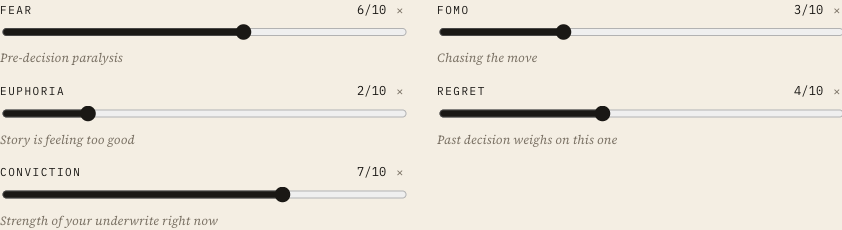
Why does investor psychology matter more than spreadsheets?
Because the spreadsheet is the easy part. The valuation work that takes a Sunday afternoon will be overridden by an emotional reflex in the thirty seconds after the position moves against you. Every investor with a multi-decade record has said some version of this. Buffett: temperament beats IQ. Munger: the big money is in the waiting, not the picking. Klarman: most of investing is psychological discipline. The valuation work matters; it just matters less than the behaviour around the valuation.
The Kahneman literature describes what Buffett and Klarman had already observed: human cognition has two systems, a fast emotional one and a slow analytical one, and the fast one runs the show under stress. Markets are designed by accident to maximise stress, because prices change in real time and the loss is visible. The investor who has not built a structure that overrides the fast system at the moments that matter (entry, drawdown, sell decision) is bringing the wrong tool to the fight, no matter how good her analytical work is.
What is FOMO and how does it actually cost retail investors?
FOMO (fear of missing out) is the impulse to buy a stock that has already moved, because watching it go up without you feels worse than the calculated risk of being wrong. The cost is not the speculative position itself; the cost is the precedent it sets. Once you have bought one position chasing the move, you have lowered your bar, and every subsequent decision is contaminated by the easier standard. The single most useful exercise is to keep a journal of the positions you almost bought and didn't. Half of them, six months later, look terrible. That memory is what protects future you from buying the next one.
FOMO is the easiest pitfall to recognise after the fact and the hardest to recognise in the moment. The internal monologue is almost always: "I am not chasing. This is a real thesis that the move confirms." Sometimes that is true. Mostly it is not. The honest test is to ask whether you would still buy the position if it had fallen 25% over the last three months instead of rising 40%. If the answer is no, you are not buying the business — you are buying the move, and the move is the part the market controls.
How does confirmation bias break investment theses?
Once you own a position, every piece of news that arrives is filtered through 'is this consistent with my thesis?' Information that confirms is amplified; information that disconfirms is rationalised or ignored. The mechanism is automatic, operating beneath consciousness, and the only effective defence is a written bear case maintained alongside the bull case. Re-read both quarterly. If you find yourself dismissing the bear case faster each time you read it, you are not getting smarter; you are getting more attached.
Pabrai's checklist discipline is partly an answer to confirmation bias: by running every position through the same fixed twenty questions, you force the disconfirming evidence to declare itself. The scoring methodology we use does the same work in a different format: every company is graded on the same six dimensions whether the news flow is good or bad. The structure absorbs the bias the human brain would otherwise apply.
What is anchoring in investing and how do I avoid it?
Anchoring is the tendency to treat the price you paid as the relevant reference for whether the position is doing well, rather than the current intrinsic value. The position is up 30% from cost (therefore good) even though it is overvalued by 40% on the work you would do today. The remedy is to re-underwrite every position annually as if it were a new buy. If the current price and the current thesis do not justify a fresh entry, the position is not 'still a hold': it is a position the anchor is preserving against the work.
The annual re-underwriting cycle is the single most reliable defence against anchoring. Pick a fixed week each year (many investors use the week between Christmas and New Year) and run every position through the same buy test you would apply to a new name. The positions that survive are the ones you actually believe in; the ones that fail are the ones the anchor was carrying. Most years, one or two positions in a concentrated portfolio fail. Most years, the act of selling them is the highest-return decision of the year.
How does herd mentality damage value investors specifically?
The value investor is by definition a contrarian — buying what the herd does not want. The damage comes during the long stretches when the herd is right. Quality compounders go through three-year periods of underperformance during which the herd is correctly avoiding them and the value investor's discipline feels indistinguishable from stubbornness. The protection is to track process metrics (was the buy thesis right? did kill criteria fire?) rather than price metrics over short horizons. The price will rejoin the value; you have to live to see it.
Bill Miller's run beating the S&P 500 for fifteen consecutive years is the textbook example, but the lesser-known story is the second decade — a long stretch of underperformance during which the discipline that made the first run looked wrong. The investors who come out of the second decade intact are the ones who could separate process from outcome, who could keep underwriting in the same disciplined way while accepting that the price would not validate the work on the timetable they preferred.
What is the impatience trap and how do experienced investors fall into it?
Impatience masquerades as activity. The investor who has not found a good opportunity in eight months starts to feel that the inactivity itself is the problem and lowers the standard to act. The cost is invisible: the next position taken at the lowered standard occupies the seat that should have been waiting for the better idea. Buffett's 'fat pitch' framing (wait for the one you can hit out of the park) is the antidote, but the discipline requires accepting that long periods of doing nothing are part of the job, not a failure.
Munger's solution is the inversion: if doing nothing is so hard, make doing nothing the default and require an unusually high bar for action. The fat pitch arrives once or twice a year for most bottom-up investors. Most decisions that are not the fat pitch are better not taken. The watchlist is for what you would buy if the price arrived; the portfolio is for the small subset of the watchlist where the price has actually arrived. Confusing the two — treating the watchlist as a buy list — is what impatience produces.
What concrete tools actually defend against psychological pitfalls?
Four work. First, a written thesis at entry, including the bear case, the kill criteria, and the price you would not buy above. Second, a 48-hour cooling-off rule between deciding to buy and executing. Third, a position-sizing constraint that is binding (no position above X% of NAV, regardless of conviction). Fourth, an annual re-underwriting cycle where every holding is treated as a fresh buy. None of these are exciting. All of them work.
All four tools share one feature: they are written down. The brain that runs your portfolio in the moment is not the brain you want running it; the brain you want running it is the one that was thoughtful at entry, when the stakes were hypothetical. Writing the rules down is what allows the thoughtful brain to constrain the reactive one. It is unromantic, deeply boring, and the single largest source of compounding edge available to a retail investor.
What this means for your watchlist
Pick the position in your portfolio that has been most volatile this year. Read what you wrote at entry. Compare the thesis you wrote to the thesis you are now defending in your head. Where they diverge, you have an anchor or a confirmation bias at work. Re-underwrite the position with the current price as a fresh entry. If the position survives the test, you have earned the right to hold it. If it does not, the work has just told you something the price was not yet ready to.